The honest answer to "how often should I restain my deck" is that the deck tells you, not the calendar. But a calendar still helps you plan and budget, and in Chicago the intervals are shorter than the national numbers because our boards go through freeze-thaw winters, wet springs and hot, humid summers every year. This guide gives the intervals we see on real Chicagoland decks by finish type and exposure, the one test that overrides all of them, and how to stretch the time between coats.
Key Takeaways
- A penetrating semi-transparent stain on a Chicago deck floor lasts about two to four years. Full sun and heavy traffic push it toward two; shade and light use push it toward four.
- Railings and other vertical wood last roughly twice as long as the floor, so they are often recoated every other time.
- Clear sealers need attention about yearly. Solid stains hold color longer but wear through in traffic lanes. Hardwood oils on ipe are reapplied every year or two.
- The water test decides: when rain stops beading and soaks in, the deck is due, whatever the date.
- A maintenance coat on a cleaned deck is a small job. Waiting until the finish fails means stripping, which is the expensive one.
The Water Test Comes First
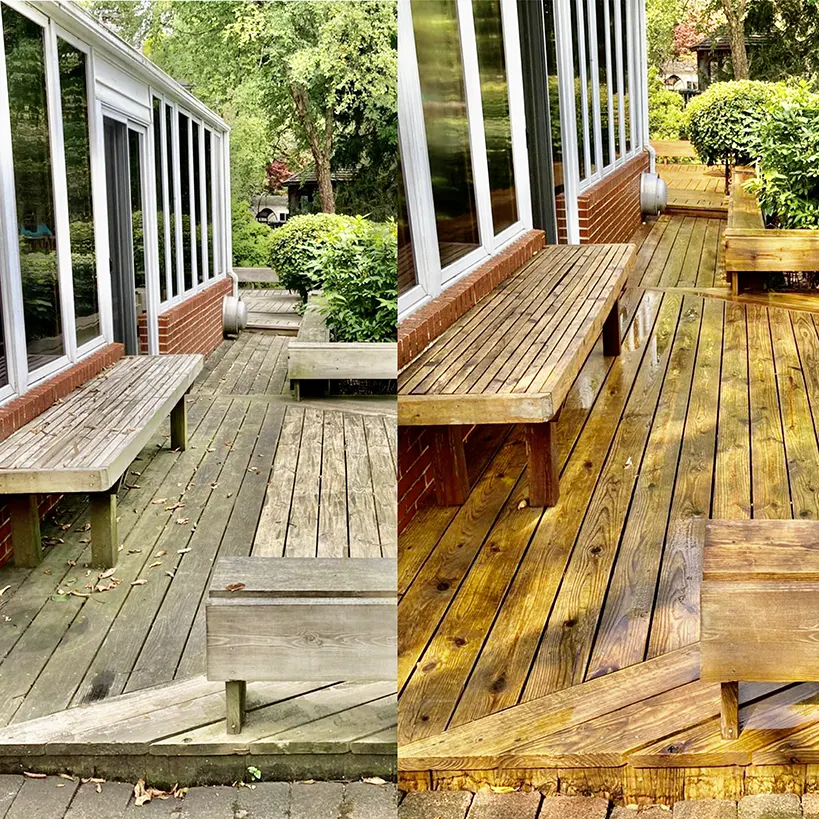
Every interval below is a planning number. The real signal is water. After a rain, or with a cup of water from the hose, look at the sunniest, most-walked boards. If the water beads and sits, the finish is doing its job. If it darkens the wood and soaks in within a minute, the protection is gone on those boards and the deck is due for a coat, even if the color still looks fine. Color fades slower than water protection does, and by the time a penetrating stain looks gray, the wood underneath has usually been taking on water for a season.
Intervals by Finish Type
| Finish | Deck floor, Chicago | Railings and vertical wood | What "due" looks like |
|---|---|---|---|
| Semi-transparent penetrating oil (our standard) | 2 to 4 years | 4 to 6 years | Water soaks in; color fades evenly in traffic lanes |
| Clear sealer or clear penetrating oil | About 1 year | 2 years | Wood grays; water stops beading |
| Solid or semi-solid stain | 3 to 5 years | 5 to 7 years | Wear-through in traffic lanes; peeling where it was applied thick |
| Hardwood oil on ipe and similar | 1 to 2 years | 2 to 3 years | Color fades toward silver; water darkens the wood |
| Paint (not recommended on deck floors) | Varies; often fails in 1 to 3 winters | 4 to 6 years | Peeling in sheets |
The two-to-four-year figure for penetrating stains matches what we tell homeowners on our products page, and it assumes the deck was properly cleaned and brightened before the coat. A stain applied over dirty or wet wood fails in a season regardless of the product.
What Moves a Deck to the Short End
- Full sun. A south- or west-facing deck with no shade takes the most ultraviolet light, and UV is what breaks a finish down. These are the two-year decks.
- Foot traffic. The path from the door to the grill and the top of the stairs wear first. Chairs dragged across the boards wear faster still.
- Standing water. Boards under planters, at low corners and where gaps are packed with debris stay wet, and wet wood sheds finish.
- Snow and ice-melt. A deck that carries snow all winter, or gets salted, comes out of spring ahead of schedule.
- The wood. Old, dry, checked boards drink stain and give it up faster than sound wood. New pressure-treated lumber can be slow to take a first coat at all; see when to stain a new deck.
Why Railings Last Longer
Vertical surfaces shed water instead of holding it, catch less direct sun, and nobody walks on them. That is why a railing usually looks fine when the floor is due. Two approaches work: recoat everything together on the floor's schedule for a uniform color, or recoat the floor alone and catch the railings every other cycle. We do both, depending on how much the color has drifted between the two.
Maintenance Coat vs. Strip and Restain
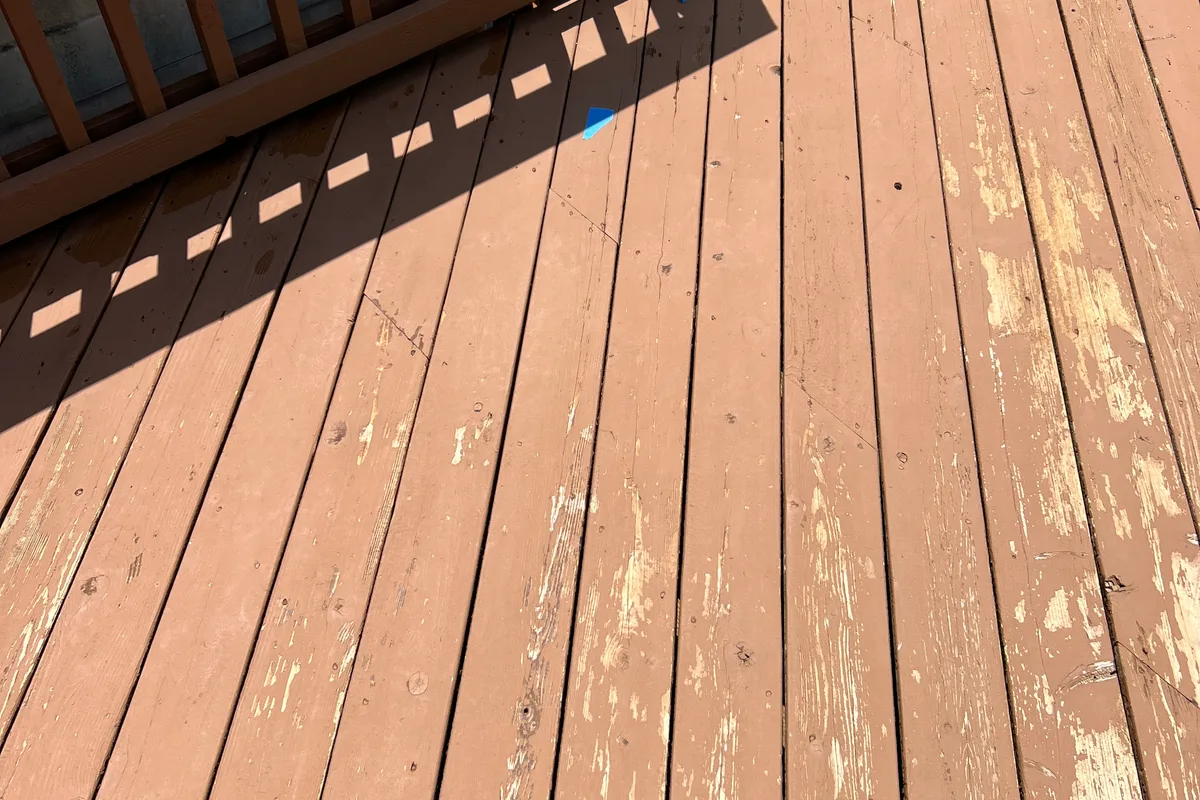
This is the reason to restain on time rather than late. A penetrating stain that has faded but not failed gets a maintenance coat: clean, brighten, dry, one thin coat, done in a day. A finish that has been left until it peels, or a film finish that has let go, has to be stripped and often sanded before anything new can go on, which is the most expensive job in deck finishing. The interval between the two states is usually one skipped season. Our deck staining cost guide shows what stripping adds to a quote.
The signs that you are still in maintenance-coat territory: even fading, water soaking in, no flaking. The signs that you have crossed over: peeling, patches that still bead next to patches that soak, and a surface that feels rough or fuzzy. Our deck preparation guide walks through both paths.
A Chicago Maintenance Calendar
- Every spring: clear the winter debris, clean the gaps between boards, wash with a deck cleaner, and do the water test on the sunniest boards.
- Every fall: clear leaves and planters, clean the gaps again, and check that water runs off the deck rather than pooling.
- When the water test fails: book the maintenance coat for the next good weather window. Late August through September is the most reliable; see our guide to the best time of year to stain a deck in Chicago.
- Every other coat: include the railings, unless they are visibly behind the floor.
How to Stretch the Interval
- Choose a penetrating stain with pigment. Even a light tint blocks far more UV than a clear finish, and pigment is what keeps the interval at the long end.
- Keep the deck clean. Dirt and mildew hold moisture against the finish; a wash once or twice a year is the cheapest maintenance there is.
- Put planters on feet and move furniture occasionally so no board stays wet for a season.
- Keep a thin coat thin. Excess stain that sits on the surface peels; a maintenance coat that penetrates does not.
- Deal with shade and drainage. Trimming a tree back or clearing a downspout that dumps on the deck adds a year to the schedule.
Frequently Asked Questions
How often should a deck be stained in Chicago?
Plan on every two to four years for a penetrating semi-transparent stain on the floor, sooner in full sun and heavy traffic, and confirm with the water test each spring.
Can I wait five years between coats?
On a shaded, lightly used deck with a good penetrating stain, sometimes. On a sunny deck it usually means the finish fails in year three and the fifth-year job becomes a strip instead of a maintenance coat.
Do I need to strip the old stain before restaining?
Not if the old stain is a penetrating type that has faded evenly and is not peeling. Clean, brighten and recoat. Stripping is for peeling finishes, film finishes and stains that still bead in patches.
How often should railings be restained?
About twice as long as the floor, so every four to six years with a penetrating stain, or every other time the floor is done.
How often does an ipe deck need oil?
Every year or two, when the color starts to fade toward silver. Ipe gets a penetrating hardwood oil, not a stain. See our ipe cleaning and oiling page.
If the water test failed this spring, request a free on-site estimate. We will tell you whether your deck needs a maintenance coat or a strip, and back the work with the Deck Doc warranty.