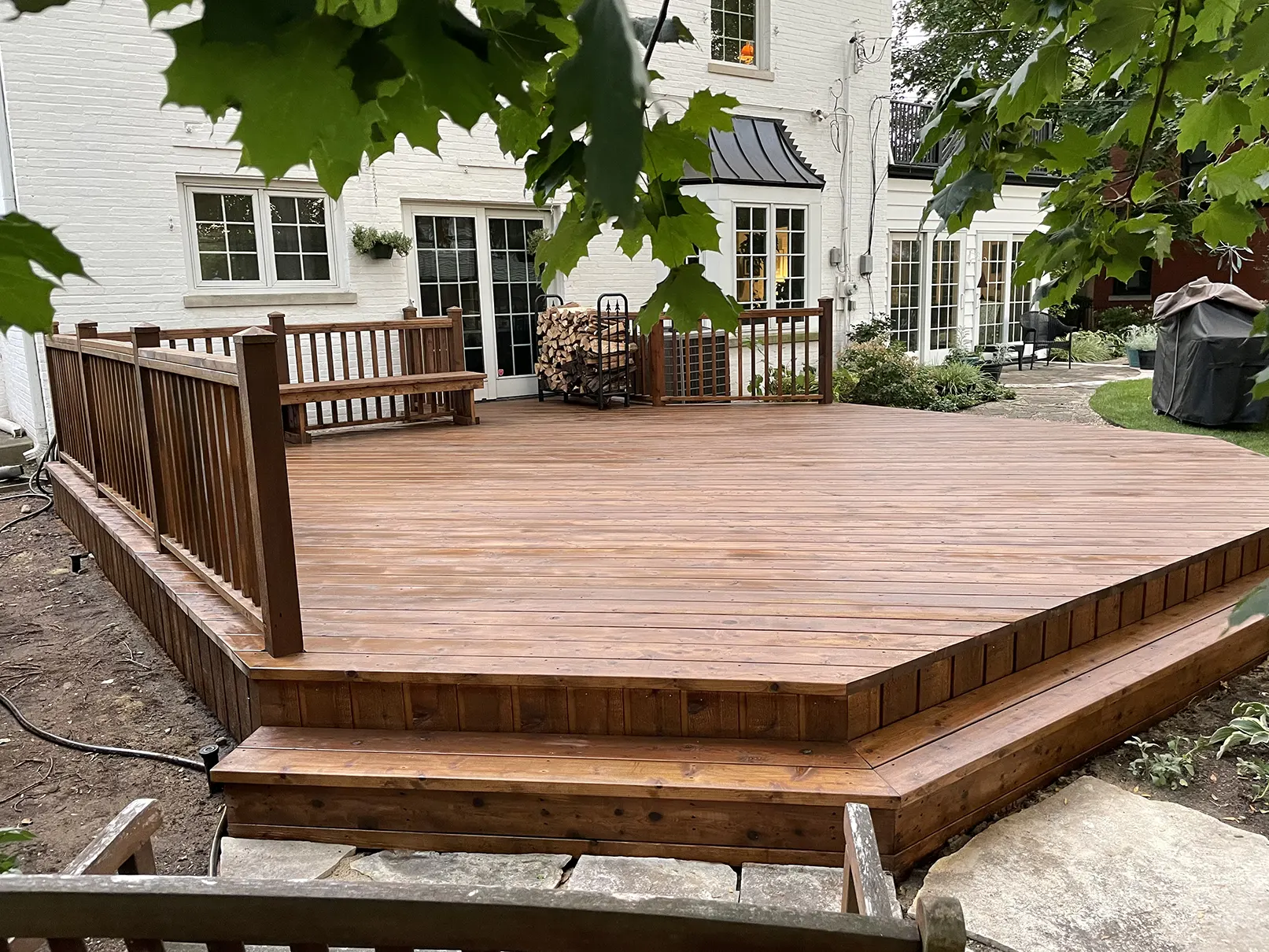
Most of what we publish about price is a rate card. This post is the other half: one real job, start to finish, with the final number on it. The deck is in Oak Park, on South Cuyler Avenue a few blocks from the River Forest border, and our Clarendon Hills crew finished it on 7 October 2026. It is the newest project on our books and a clean example of the deck restoration we do most often: a wood deck with nothing wrong in the framing that has lost its finish, its color and one piece of railing.
The job file
- Where: Oak Park, IL, near the River Forest border
- The deck: 360 square feet on two levels, with stairs, skirting, a landing apron, railings, a built-in bench, a table and counter, and a garden box
- Condition: finish worn through and pulling away, grain opened up, one handrail past saving
- The work: power wash, power sanding of every horizontal surface, one handrail replaced, one coat of Rymar Xtreme Weather semi-transparent oil in Sienna
- Crew: Clarendon Hills
- Final price: $3,050
- Photos: the Oak Park deck restoration project page has the full before and after set
First look: a deck that had stopped shedding water
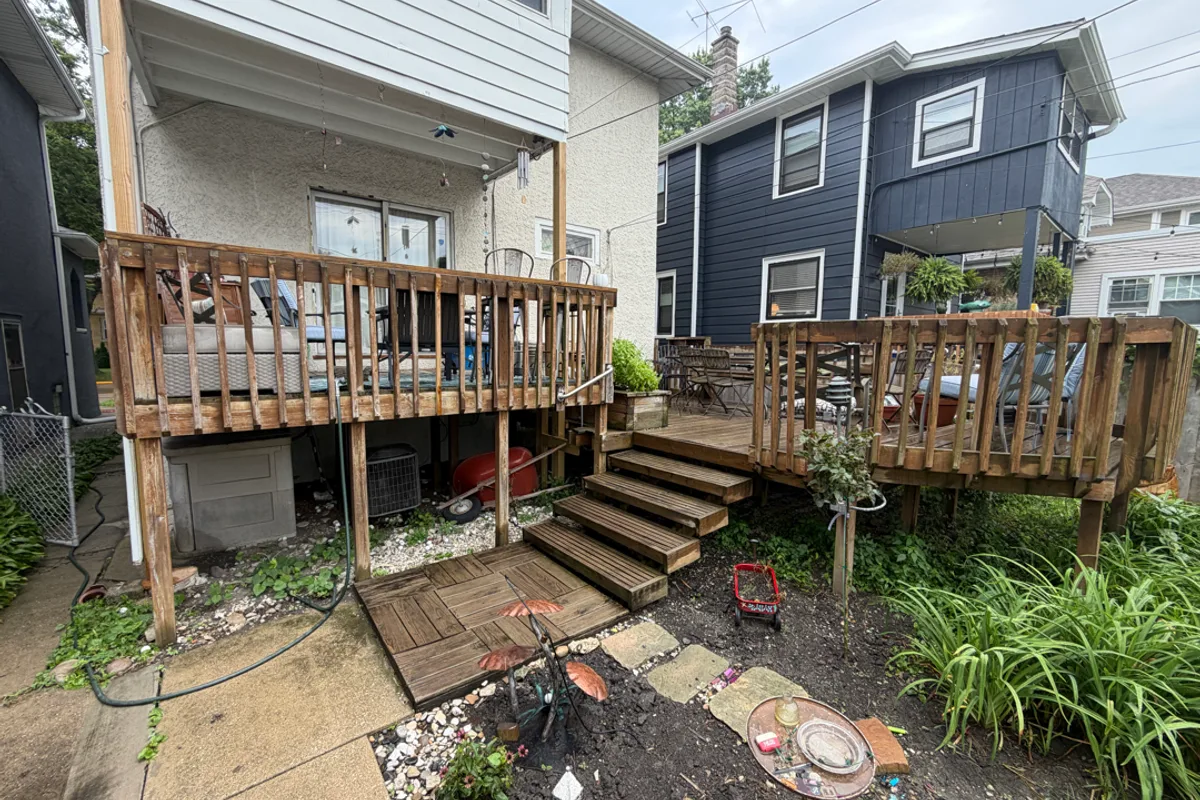
Nothing on this deck was broken in a way you would notice from the kitchen window. That is typical of the calls we get in the fall.
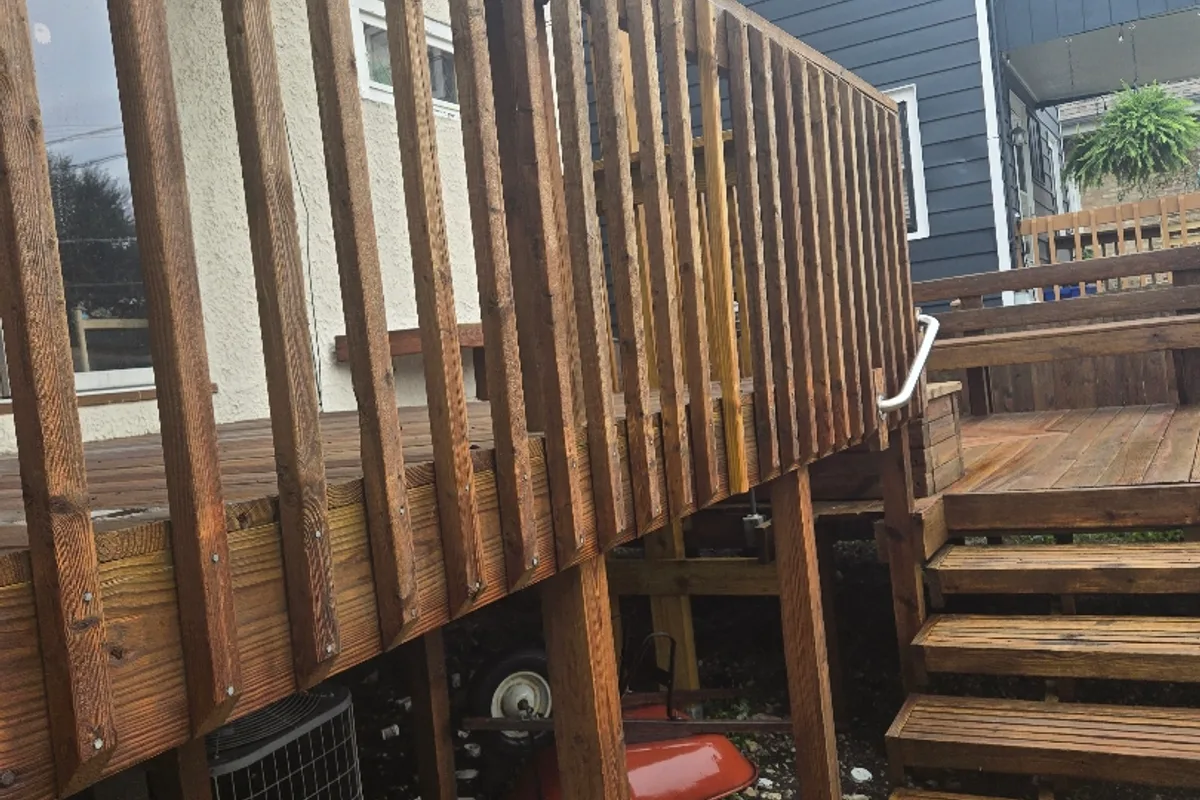
The floor, stairs, railings and built-ins had all gone the same flat gray. The old finish was pulling away in patches. And the grain had opened up, so every rain soaked in instead of beading off.
Open grain is the stage that matters. Once the finish stops sealing the surface, the wood drinks water every time it rains and gives it back every time it dries. That cycle is what checks boards, raises splinters and starts rot at joints and end grain. A finish that peels and flakes is a later stage of the same problem; our post on why decks peel shows where it ends up.
Why shade wears out a deck finish faster than sun
Oak Park is one of the older, leafier suburbs we work in, and this backyard is a good sample: houses close on both sides, a second story over part of the upper deck, and tree canopy toward River Forest.
Shade feels kind to wood. It is not. A shaded deck stays damp for hours or days after rain, while a deck in full sun is dry by lunch.
Wood is always trading moisture with the air, swelling as it takes water on and shrinking as it dries; the U.S. Forest Service covers this in the moisture chapter of its Wood Handbook. Slow drying means the boards spend more of the year wet, mildew gets a longer season, and a finish that is not built for those conditions breaks down from underneath. On a deck like this, the product choice matters more than the color.
Restore or replace? How we made the call
The first question on every walkthrough like this one is whether the deck is worth saving. We answer it by looking at the framing before the finish. Posts, beams, joists and the ledger where the deck meets the house decide whether a deck is a refinishing job or a rebuild. The boards, railings and color only decide what the refinish includes.
Nothing in this deck's framing called for structural work, so restoration was the clear choice. Rebuilding a two-level deck with stairs and built-ins would have cost many times the $3,050 this job came to. Our guide on whether to repair or replace an old deck walks through the checks we make and the point where we tell people to rebuild instead.
What the crew did, in order
- Power wash. The whole deck, built-ins included, to lift the loose remains of the old finish and the dirt and mildew sitting in the open grain.
- Power sanding on every horizontal surface. Floor boards, stair treads, bench and counter. Sanding takes off the gray, damaged fibers at the surface and gives the new oil clean wood to soak into, which a wash alone cannot do on wood this far gone.
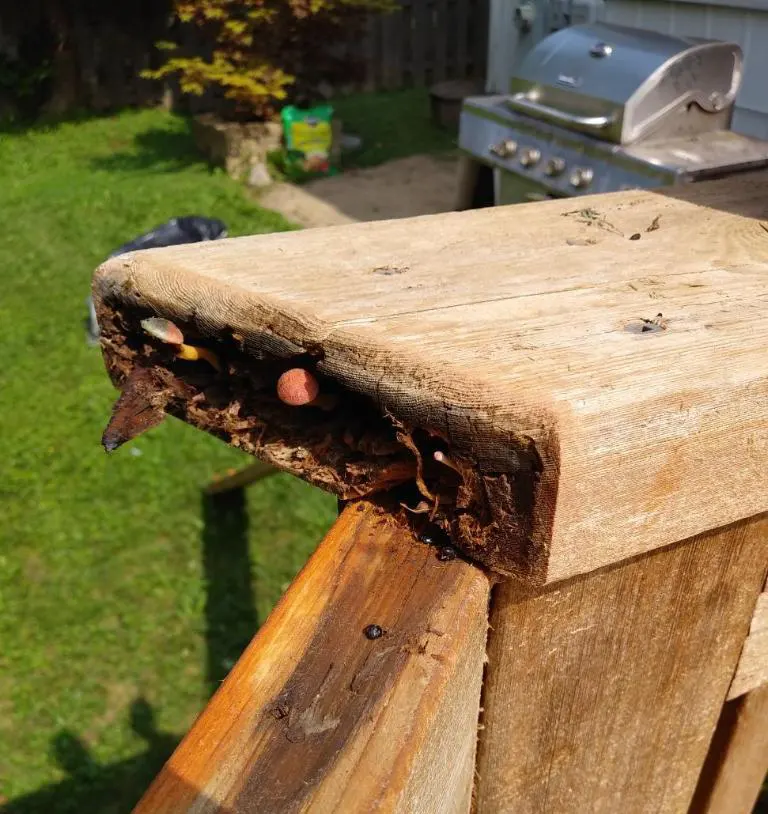
- One handrail replaced. It had deteriorated past refinishing, so it was replaced with the homeowner's approval before any stain went down. That way the new rail took the same coat as the rest of the deck.
- One coat of Rymar Xtreme Weather in Sienna. An oil-based semi-transparent, applied to the floor, stair treads and risers, railings, posts, skirting, bench, counter and garden box.
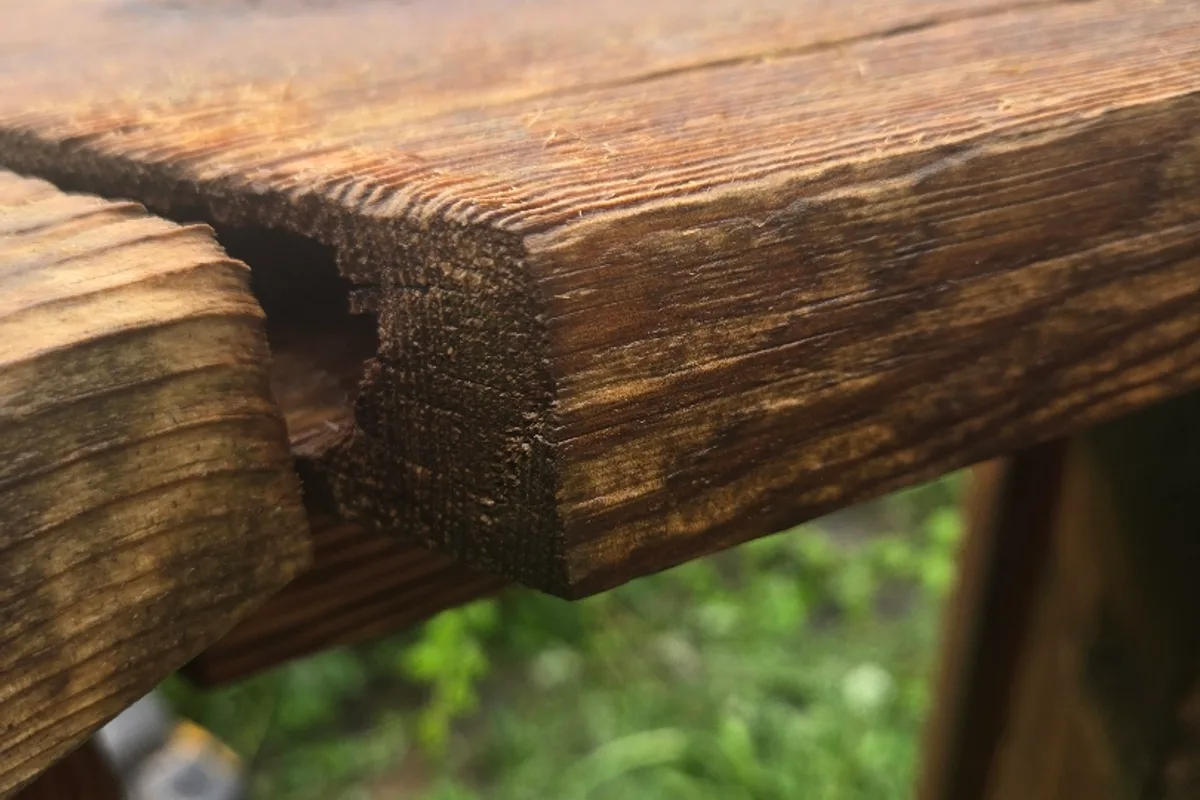
The railing is the part of a restoration we never skip past. A soft or loose rail is a safety problem before it is a cosmetic one, which is why loose railings are on the North American Deck and Railing Association's deck safety checklist. When we find one, it goes on the estimate as its own line so you can see exactly what it costs.
Why a semi-transparent oil and not a solid stain? A penetrating stain soaks into the wood instead of forming a skin on top, so there is no film to peel when a shaded deck stays damp. A solid stain would have covered the gray faster. It would also have been the wrong finish for this deck.
That is not only our preference. The General Services Administration's preservation guidance on semi-transparent and opaque wood stains draws the same line: penetrating stains resist peeling and blistering, while film-forming solid stains are not recommended for decks and porch floors. Rymar Xtreme Weather is the penetrating oil we use on most wood decks, and our products page explains why we chose it over the alternatives.
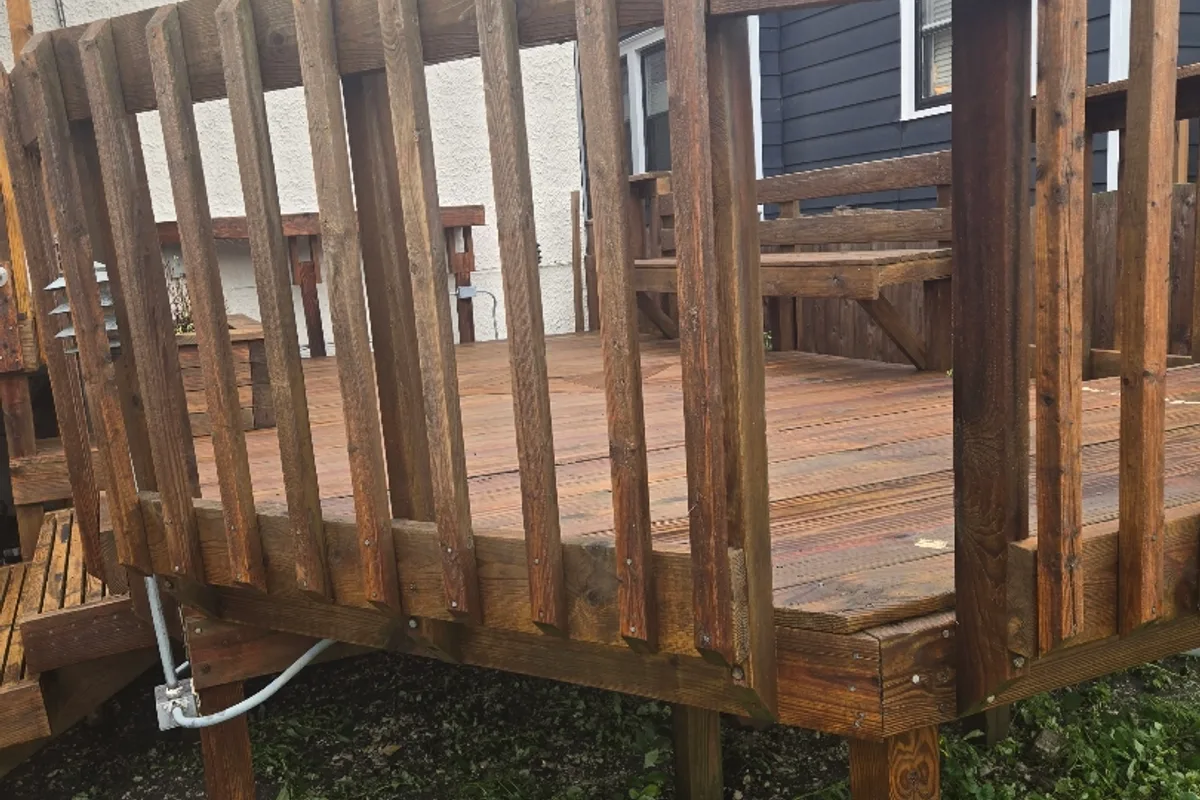
Where the $3,050 went
We do not publish a customer's invoice line by line. Every estimate we write comes from the same rate card, though, and our deck staining cost guide publishes that rate card. Here is how a deck like this one adds up against it.
| Line | Our published rate | On a deck like this |
|---|---|---|
| Wash and stain, 200 to 400 sq ft with a railing | $1,700 to $2,100; penetrating oil sits at the top of the range | About $2,000 to $2,100 |
| Sanding the horizontal surfaces | $1.25 to $2.00 per sq ft depending on the old finish, plus supplies | About $500 to $800 |
| Handrail section | $110 per section, installed | $110 |
| Bench, table and counter, garden box, skirting and apron | Measured as area and added at the deck's rate | The remainder |
| Inside-the-city adjustment | About 10% inside the Chicago city limits | $0, because Oak Park is a suburb |
| Total | $3,050 |
That works out to about $8.50 a square foot. A plain deck of the same size that only needs a wash and a coat of oil lands closer to $5 or $6. The difference here is the sanding, the railing, and the built-ins, which add a lot of surface without adding floor area.
What waiting two more years would have cost
A deck in this condition does not get more expensive gradually. It gets more expensive in steps:
- Soft boards. Gray, open wood that keeps soaking up water starts to go soft at the ends and around fasteners. Replacing a pressure-treated board on a one-story deck is about $115 installed, and boards rarely go one at a time.
- A failed film finish. When a solid stain or paint goes on over wood like this and peels, it has to come off before anything new will hold. Full removal is $4 per square foot, about $1,440 on a deck this size, on top of the refinish itself. This deck's removal was a wash and a power sand, which is far cheaper.
- Framing. Once water reaches the joists or the ledger, the conversation changes from refinishing to structural repair, which is quoted after an inspection.
The cheap path runs the other way. A wash alone on a deck this size with a railing is $600 on our rate card, and a yearly wash is often what separates a quick maintenance coat in year three from sanding and repairs in year five. If your deck already looks like the before photo, a full deck restoration is where to start; if it still beads water, a wash and an inspection may be all it needs this year.
Keeping Sienna looking like Sienna
One coat of penetrating oil is not a forever finish, and we would rather say so up front. The GSA guidance above puts a single coat of oil-based semi-transparent stain at two to four years. Expect the shorter end of that on a shaded deck.
This homeowner has a maintenance wash available on request within the next 18 months, and the finish is covered by our 18-month warranty against peeling. For any shaded deck, our advice is the same:
- Wash it once a year, in spring or after the leaves come down.
- Do not let wet leaves, rugs or planters sit on the boards for weeks at a time.
- Recoat when water stops beading on the floor, not when the color is gone.
Questions we hear on Oak Park walkthroughs
How much does deck restoration cost in Oak Park?
This 360 square foot deck with railings, stairs and built-ins came to $3,050, about $8.50 a square foot. A simpler deck of the same size that needs only a wash and a coat of oil runs $1,700 to $2,100. Oak Park is priced as a suburb, so the roughly 10% we add inside the Chicago city limits does not apply.
How long does a restoration like this take?
Two to three days for a deck this size: washing, sanding and repairs first, then the stain once the wood has dried. Rain moves the schedule, because we do not stain wet wood.
Will a replaced board or rail match the rest of the deck?
Closely, when it is replaced before the stain goes on, as the handrail was here. New wood absorbs stain a little differently from weathered wood, so it can read slightly lighter or darker for the first season.
Do I need a permit to restore a deck in Oak Park?
Not for cleaning, sanding and staining; finishing work needs no building permit anywhere in Chicagoland. Structural work such as new posts, beams or a ledger is different, and the Village of Oak Park decides what that requires. We tell you on the walkthrough if your job crosses that line.
Who handles deck work in Oak Park?
Our Clarendon Hills office covers deck staining and restoration in Oak Park, along with River Forest, La Grange, Western Springs, Hinsdale and Clarendon Hills.
Deck Doc is family-owned and has been restoring decks across Chicago and the suburbs since 2015. Every job is covered by our $1 million general liability policy with State Farm, finishes carry an 18-month warranty against peeling and repairs carry two years, and homeowners have rated us 4.9 stars across 229 Google reviews. For a walkthrough and a written estimate on your own deck, call the Clarendon Hills office at (630) 822-7131.