“It was 68 and sunny all week — why is my deck still tacky?”
That is the call our Northbrook office takes over and over every fall, almost always from someone who did the job themselves the weekend before. Clean deck, dry boards, thin coats, a beautiful stretch of October afternoons. And the stain still will not cure.
The answer is almost never what happened during the day. It is what happened at three in the morning. We have been staining decks across Chicagoland since 2005, and the most expensive misunderstanding we see is this one: staining season here does not end when it gets cold. It ends when the nights get cold — about two weeks earlier than anyone expects.
Key Takeaways
- The overnight low, not the afternoon high, decides whether stain cures. At O'Hare the normal low drops below 50°F on October 4 — while the normal high is still 68°F.
- Oil stains like TWP 1500 need 50°F; water-based products like Woodluxe hold to 40°F — roughly three weeks of difference in your deadline.
- The normal first fall freeze at O'Hare is October 19; we stop booking oil staining well before that.
- A deck that still beads water does not need re-staining at all. We say so on-site, often.
The Number That Ends Staining Season Isn't the Daytime High
Every stain we carry prints an application temperature range on the can, and homeowners read it the way they read a weather app: as a daytime number. It is not.
TWP 1500 Series is our workhorse oil-based penetrating stain for cedar and pressure-treated decks. Per the manufacturer's own TWP application temperatures, it “may be applied as cold as 50°, or as warm as 85°.” The same page is blunt about a drop afterward: the stain “will not dry until the sun comes out and warms the surface,” and the deck “will be sticky for several days.”
Stain does not check the temperature once, when the brush touches the board. It keeps checking for the entire cure. Start at 2 p.m. on a 68-degree October afternoon and by 4 a.m. those boards sit at 44 degrees, cure barely underway. So when we build the fall calendar for Chicago deck staining, we schedule against the low.
What Actually Happens to Stain on a 45-Degree Night
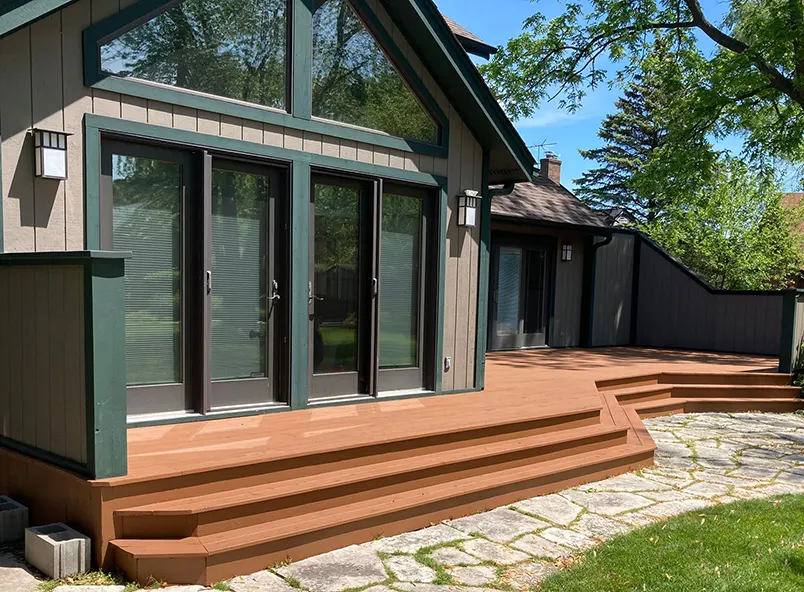
Penetrating stains cure by letting their carrier evaporate so the resins harden inside the wood fiber. Cold interferes twice: evaporation slows to a crawl, and the deck radiates heat to a clear night sky until it is colder than the air — so dew forms on a finish that has not set.
What our crews find on these repair calls is consistent: a tacky surface with leaves and pollen locked in it, shiny lap marks where uncured stain pooled, and a film sitting on the wood instead of in it. That last one is the expensive outcome — the first freeze-thaw cycle lifts it off in sheets, and stripping a failed coat costs more than the original job did. It is also why we treat deck sealing as its own scheduling question.
Chicago's Real Cutoff Dates, by Product
Here is what our crews work from. These are start dates, and they assume the deck is already clean and dry.
| Finish | Minimum temp | Last comfortable start |
|---|---|---|
| Oil-based penetrating stain (TWP 1500, Rymar Xtreme Weather) | 50°F | Around October 1 |
| Water-based stain and sealer (Benjamin Moore Woodluxe) | 40°F | Around October 20 |
| Hardwood and Ipe penetrating oil | 50°F, slowest cure | Late September |
Which one applies depends on your wood and the finish already on it; we list the full lineup on our deck stain products page. Back these dates up if the deck needs work first — cleaning, two to five drying days, then finish. A deck restoration with board replacement pushes the start back another week or more.
The O'Hare Numbers Behind Those Dates
We did not pick those dates by feel. Pull the Chicago climate normals — the 1991–2020 daily averages the National Weather Service keeps for O'Hare — and the collapse shows up in the low column while the highs still look fine.
| Date | Normal high | Normal low |
|---|---|---|
| September 30 | 69.8°F | 51.3°F |
| October 4 | 68.0°F | 49.7°F |
| October 15 | 63.2°F | 45.7°F |
| October 31 | 55.9°F | 40.1°F |
October 4 is the hinge — the first day the average overnight low at O'Hare falls under 50 degrees, the floor for every oil stain we use, while the average afternoon is a gorgeous 68. Everything your body says about the weather says go. The can says stop.
By October 15 the normal low is 45.7, cold enough that a washed deck will not dry down to the moisture content stain needs. The normal first fall freeze lands October 19, and by Halloween the normal low of 40.1 sits on the floor for water-based products too. That is why fall deck maintenance gets sequenced differently than the spring version.
Missed the Window? Do These Free Things First
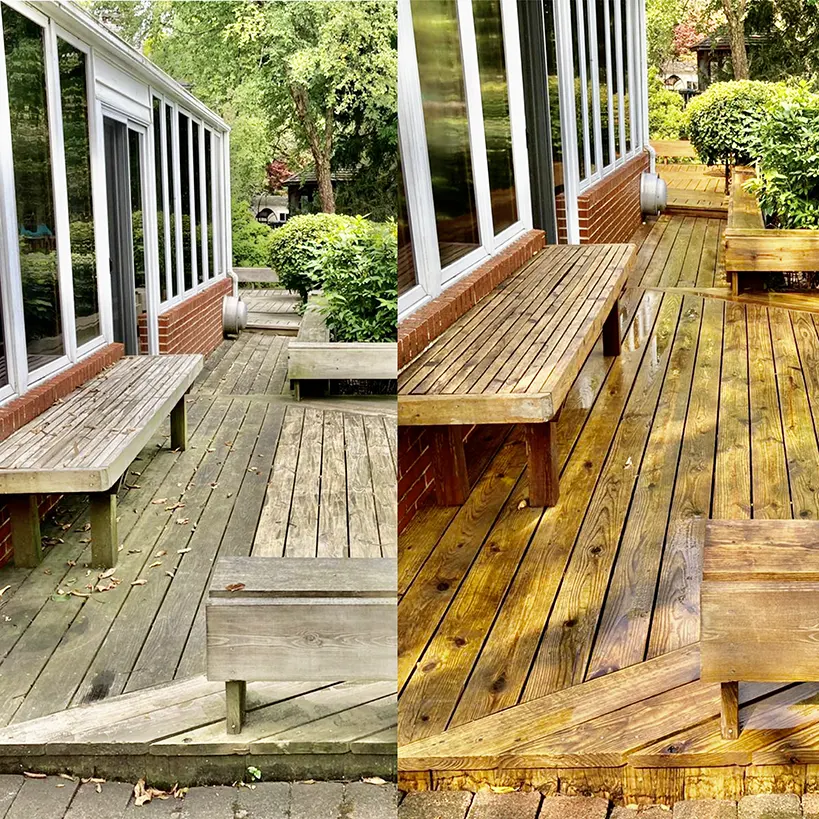
If the calendar has passed you, do not hunt for a warm Saturday and sneak the job in. Do these instead — they cost nothing and do more before April than a rushed coat would.
- Sweep weekly once leaves start dropping. Wet leaves leach tannins and leave black stains that survive a spring wash. In the older neighborhoods we work in — Oak Park, Evanston, Hinsdale, Wilmette — this habit alone decides whether spring means a light cleaning or a full strip.
- Get furniture, planters, and mats off the wood. Anything lying flat holds moisture against the boards through every freeze-thaw cycle. Rubber-backed mats are the worst offenders we see.
- Clear the gaps between boards. Packed debris stops drainage and turns the deck into a tray.
- Check where downspouts dump. A gutter overflowing onto one corner rots it years ahead of everything else.
- Walk the shaded north side. It dries slowest, so it fails first. Soft boards there are a spring repair, not a staining job.
- Skip the tarp. Covering a deck traps moisture instead of letting it breathe. We have pulled tarps off in March and found more rot underneath than on the uncovered half.
- Book a wash, not a stain. Our deck cleaning service tolerates cool weather far better than finishing does.
When Your Deck Doesn't Need Staining at All
Before worrying about the deadline, find out whether you have a job at all. Splash water on a few spots — a sunny board, a shaded board, a stair tread. If it beads and sits there a minute, your finish is intact. Put the cup down and go do something else.
We turn down staining work for this reason more often than people expect, and it costs us jobs every fall. Piling a fresh coat over a finish that has not worn through does not add protection; it adds thickness, and thickness is what cracks, clouds, and peels. Most Chicagoland decks want recoating every two to three years, not annually. If you cannot tell where yours sits, request an on-site free estimate and we will walk it with you.
What a Fall Deck Project Costs With Deck Doc
When a deck does need the work, here is what we charge in Chicagoland. Final numbers depend on size and condition, confirmed after the walkthrough.
| Service | Typical cost |
|---|---|
| Deck cleaning & wash | $150 – $500 |
| Inspection & condition report | Free with service |
| Re-seal / clear coat | $1.50 – $3.50 / sq ft |
| Re-stain & seal | $2.50 – $5 / sq ft |
| Minor board or fastener fix | $40 – $150 |
| Seasonal maintenance package | $400 – $1,500+ |
On a typical 300 square foot deck that is roughly $300 to clean and wash, about $750 to re-seal and clear coat, and around $150 to reset fasteners — near $1,200 all in, with no hidden fees.
The reason we will talk you out of spending that in late October is the same reason we are still here twenty years on. Deck Doc has been family-owned since 2005, our crews are trained in-house rather than subcontracted, we carry $2M in liability coverage as a licensed and insured contractor, and every job is satisfaction guaranteed. A guarantee only means something if we refuse the jobs that are going to fail.
Doing it right also means measuring instead of guessing. The Woodluxe technical data sheet specifies wood moisture at or below 15% and air and surface temperatures between 40°F and 90°F — readings, not opinions, which is why a moisture meter rides in every one of our trucks. See the results in our deck project gallery, or reach us through contact Deck Doc.
What We Tell the Homeowner Who Calls Us on October 20
This conversation happens at our Northbrook office every fall. Here is how it goes.
Someone calls, usually a little embarrassed, because the deck has looked rough since July. We still come out; the estimate is free either way. On-site we check what finish is left, probe for soft boards, check railings and stair treads, and take a moisture reading.
Then, most of the time in late October, we say the same thing: we are not going to stain this now. We will clean it and make repairs while the weather allows, so the deck goes into winter with nothing rotting and nothing loose — then book them early for spring.
Homeowners are often surprised we turn down the bigger job. But we have watched the alternative play out: a rushed October coat looks fine for three weeks, the wood moves through a Chicago winter under a finish that never bonded, and by April they are calling about deck stain peeling — now paying us to strip the coat they already paid for. Book earlier instead; we make the full case in our post on late August staining.
Your Fall Deck Checklist
- Do the water test on three spots. Beading means skip staining altogether.
- Identify your finish. Oil-based means an early-October deadline; water-based means late October.
- Count backward: cleaning, plus two to five drying days, plus staining.
- Watch the overnight lows, not the highs — three consecutive nights above your product's minimum, or do not start.
- Sweep leaves weekly, and lift furniture, planters, and mats off the boards for winter.
- Clear the board gaps, and check that gutters are not dumping onto the deck.
- Probe the shaded side for soft boards and flag them for spring. Leave the deck uncovered — no tarps.
- If staining waits, still get cleaning and repairs done in fall. Our guide to deck prep before staining covers that groundwork.
Frequently Asked Questions
Is it too late to stain my deck in October in Chicago?
For an oil-based stain, usually yes after the first few days of the month. TWP specifies a 50-degree minimum, and the O'Hare normals put the average overnight low below 50 starting October 4. Water-based products buy about three more weeks. We schedule around the low at every one of our Chicagoland service locations.
What's the minimum temperature to stain a deck?
It depends on the product. TWP 1500 Series, our oil-based stain for cedar and pressure-treated wood, may be applied as cold as 50 degrees. Woodluxe, our water-based option, calls for air and surface temperatures between 40 and 90. Either way, that temperature must hold through the entire cure.
Can I stain if it's warm during the day but cold at night?
No. TWP's own guidance is direct: if the temperature drops after application, the stain will not dry until the sun comes back out and warms the surface, and the deck will be sticky for several days — collecting leaves and grit and curing unevenly.
Should I just wait until spring instead?
If the window has closed, yes. Waiting costs a season of appearance; staining too late costs the finish and the money spent on it. Clean and repair in fall, stain in spring. Read more about Deck Doc and how we work.